Step-by-step plan: Employing staff in the Netherlands


Do you want to employ permanent or temporary staff? You can use this step-by-step plan to find out which obligations you must fulfil and what you need to arrange.
This step-by-step plan also includes a number of obligations relevant to employing staff from outside the Netherlands. If the information you are looking for is not on this page, please consult the other articles in this section.
Most of the regulations concerning hiring staff apply to both permanent and temporary staff. But there are some differences. If you plan on hiring temporary staff through an agency or secondment supplier, take into account the following:
- Check whether the agency or secondment supplier is listed in the Dutch Business Register: as a hirer, you risk a fine for working with suppliers that are not registered properly. You can check their registration using the KVK (Dutch-language) Waadi check (Workers Allocation By Intermediaries Act, Waadi). Also check that this supplier is SNA-certified. Then you run less risk of claims from the Tax Administration if this company fails to meet its obligations.
- Make sure the intermediary has arranged a work permit for your temporary workers from outside the EEA/Switzerland.
- Avoid liability for taxes owed by your intermediary; the Netherlands Tax Administration may hold you liable for the payroll tax and turnover tax owed by your intermediary. One way of preventing liability for payroll tax and turnover tax is to ask the organisation that hires employees out to you to set up a blocked account (G account).
- If the temporary worker you hire is foreign, they may still be covered by social insurance in their own country. In that case, you do not have to pay social security contributions for this worker. To be certain on this point, you can ask your intermediary to submit an A1/certificate of coverage.
When looking for employees, you should follow rules for equal treatment of candidates. For example, make sure the job description is neutral so that everyone feels welcome to apply. During an interview, you are not allowed to ask questions about health or private life. Or about someone's family or desire to have children.
Finding matching candidates starts with good job ads and the right approach. With these tips from KVK, you can create a clear job advertisement that will stand out.
Read more about creating a diverse and inclusive workplace.
You may only employ staff whose identity you know and who are allowed to work in the Netherlands. You must always check this before employing anyone. This is known as the verification requirement. This also applies if you want to hire foreign staff or interns.
Verify the identity of all workers on the basis of an original identity document, such as a passport. Note that a driving licence or a statement from the Netherlands Tax Administration is not valid proof.
When checking the ID, pay attention to:
- the passport photo
- characteristics such as age and height
- signature
- nationality
- whether the document is still valid
- authenticity features, such as watermark and document number
Use the Netherlands Labour Authority's step-by-step plan for the verification obligation.
Are you hiring someone for a job where integrity-sensitivity is important? For example, because they will handle confidential information or deal with money? Then you should screen them first. A background check allows you to assess whether someone is trustworthy. This helps you to limit risks. You can also screen temporary staff. Such as iinterim personnel, self-employed professionals, temporary staff, interns, and volunteers.
Find out more about screening job applicants (in Dutch).
Personnel and privacy
When you store employees' personal data you must follow the European privacy law, GDPR. For example in screening, recruitment and selection, and the creation of a personnel file.
The Dutch Data Protection Authority (Autoriteit Persoonsgegevens, AP) has a checklist available (in Dutch)so you know what to look out for.
Process all mandatory data in your records before your employee starts. Such as:
- payroll tax records (in Dutch)
- a copy of the employee's proof of identity
- payslips
Download an example of a payslip (in Dutch). If you make your own payslip, it should contain the same data as the example.
Are you employing personnel for the first time? You must register as an employer with the Netherlands Tax Administration. You will then receive the forms you need for your payroll tax obligations.
You must also inform KVK of employee changes.
Read what else you need to take into account when hiring staff for the first time.
Can a sole proprietor employ staff?
Sole traders can hire personnel or temporary employees; the term 'sole' only refers to the legal liability of the business structure.
You must inform your employee about the main terms and conditions of employment so that they know what rights they have. You can enter into an employment agreement in writing or verbally. But, it is advisable to set out the terms of the agreement in writing, otherwise confusion may arise regarding the agreements. There are certain details that you must always provide in writing within 1 week and within 1 month of your employee starting work.
In an employment contract, you specify the employee’s salary, indicate whether a Collective Labour Agreement (CAO) applies, and indicate whether you arrange an employee pension scheme. A contract will include information on:
- holiday entitlement and public holidays
You cannot view this video due to your cookie settings. Would you like to watch?or Watch this video on YouTubeHow cookies are used on Business.gov.nl.- Everyone working in the Netherlands is entitled to the Dutch minimum wage and a holiday allowance. This also applies to temporary workers, flex workers, and foreign personnel.
- There is no minimum youth wage for employees aged 13 and 14. You agree together on how high their wage is.
- Young people under 18 are also subject to rules on, for example, the type of work and working and rest times.
Personnel costs
Besides salary, you will face various costs when hiring staff. Such as holiday pay, payroll taxes and extra (secondary) benefits. Read which personnel costs you need to think about.
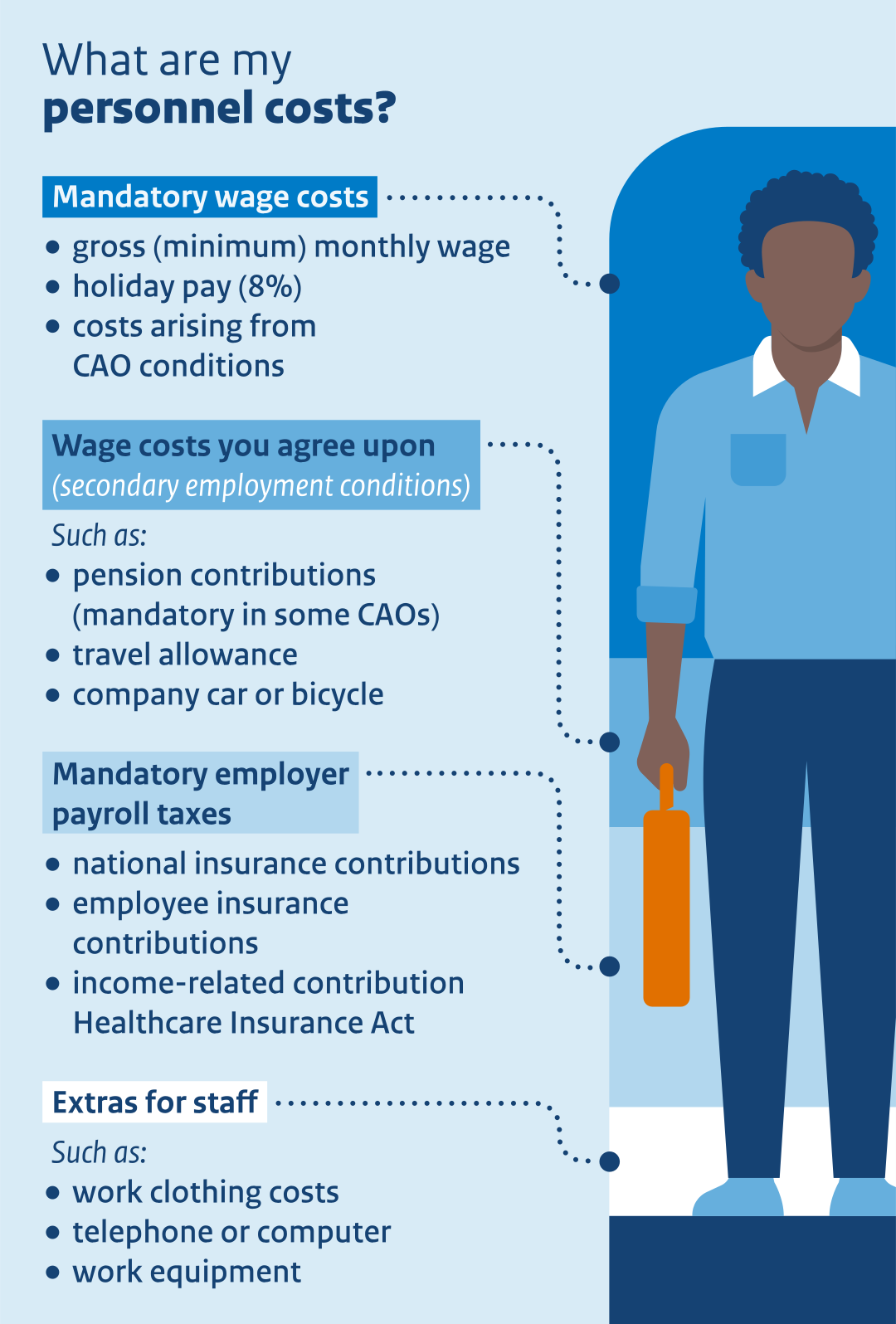
What are my personnel costs?
The infographic shows four categories of personnel costs.
- Mandatory wage costs:
- the gross (minimum) monthly wage
- holiday pay of 8%
- costs arising from collective labour agreements (CAO)
- Wage costs that you agree upon (secondary employment conditions), for example:
- a company car or bicycle
- travel allowance
- pension contributions (sometimes mandatory under the CAO)
- Mandatory payroll taxes for the employer:
- national insurance contributions
- employee insurance contributions
- income-related contribution under the Healthcare Insurance Act
- Extra personnel costs, for example:
- the costs of work clothing
- telephone or computer
- work equipment
Your employee must be able to work safely and healthily. This is stated in the Working Conditions Act (Arbowet). According to this act, you must draw up a health and safety policy. This policy describes everything you do to ensure your employees can work safely and healthily.
And you must conclude a contract with a health and safety service provider. The contract specifies the tasks for which you must be supported by a health and safety service provider or company doctor. For example, when your employee is ill (long-term). And preventing absenteeism.
Once you employ personnel, you are obliged to draw up a risk assessment and evaluation (RI&E). In the RI&E, you record the risks faced by personnel and the measures you have in place to prevent these risks. The Netherlands Labour Authority checks whether you have an RI&E.
Read more about drawing up a RI&E
Use the tools and instruments of Steunpunt RI&E
You can make your own RI&E or use the instruments and tools from the Steunpunt RI&E (in Dutch). There are RI&E tools for different industries. There is also a general RI&E for SMEs.
If your employee works in the Netherlands, you must pay social insurance premiums. You pay employee and national insurance contributions to the Tax Administration.
Become self-insurer
You can choose to become a self-insurer for employee insurance (eigenrisicodrager) in the event of illness (Sickness Benefits Act) or incapacity for work (WGA). You will then pay less in employee insurance contributions. If your employee becomes ill or unfit for work, you will pay the benefit instead of UWV.
Your employee should have taken out a standard Dutch healthcare insurance policy. If they are not insured or do not pay their monthly premiums, the Dutch National Health Care Institute (CAK) will take out health insurance for them. You then have to deduct the healthcare premium from their salary, and pay it back to the CAK.
Find out more about late payments of health insurance premiums from the CAK (in Dutch).
You are obliged to offer your employee a pension scheme if there is a specific pension fund or a occupational pension scheme for your sector. Or if it is stated in your CAO. Is this not the case? Then you can choose whether to offer your employees a pension scheme. Learn more in the step-by-step plan on how to arrange a pension for your employees.
You cannot view this video due to your cookie settings. Would you like to watch?or Watch this video on YouTubeHow cookies are used on Business.gov.nl.Personnel Guide: everything you need to arrange at a glance
Are you hiring staff for the first time? Or do you spend a lot of time on personnel matters? The Staff adviser on the KVK website provides advice in your situation. For example, what you need to arrange when hiring staff. Or what to think about when your business grows.
Try to find personnel in the EEA first
You are obliged to recruit personnel initially in the European Economic Area (EEA) and/or Switzerland. Only if you prove that you cannot find suitable personnel here will you be permitted to recruit from other countries.
Apply for a work permit (if needed) or a combined permit for residence and work
If you employ someone who is not from the EEA or Switzerland for less than 3 months, you must apply usually for a work permit from the Employee Insurance Agency (UWV). If you employ someone for 3 months or longer you must usually apply for a combined permit for residence and work: the Single Permit.
Organise suitable accommodation when employing foreign staff
You are obliged to find suitable accommodation for employees who need a work permit. You must observe the relevant rules applicable in your municipality.
Posting to the Netherlands
If you are hiring temporary posted workers from a company in an EEA country or Switzerland, the company providing the seconded workers has to notify the Dutch government. In certain professions, self-employed professionals also have to notify the government. You can find all information on who needs to notify and how on the Ministry of Social Affairs and Employment Posted workers website, which is available in English, Dutch and German.